László Kozma :: ProjectsNote of warning: this page has not been updated in about a decade, so probably nothing of interest here :) Below are links to some fun projects and experiments that I worked on in my free time, in the past several years --- a.k.a. throwing stuff at the wall... These "projects" are very uneven in scope: some are throwaway blogposts written in half an hour, others are quick implementations of an idea, a few of them represent years of work; some are still occasionally improved and (hopefully) useful to someone, others are abandoned and (in case of software) might not even work anymore due to changes in technology, etc. VisualizationsWikipediaVision is an (almost) real-time visualization of Wikipedia edits and what part of the world they come from. I made it in 2007, and it has been by far the most viewed item on my site, with wide press coverage, and displayed in museums, parties, etc. I try to keep it up and running, until it becomes too much of a headache. This is a visualization of the Cuckoo hashing data structure in computer science. Here are two static visualizations of data sets: the languages of the world, based on the WALS data set, and a map of all named colors, from Acadia to Zucchini.
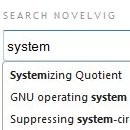
User interface experimentsColor-changing links are a simple way of organizing a list of links (also made in 2007), with the color of a link showing how often the link is clicked. One can create new collections, and I got into the habit of using it for bookmarking, but, to be honest, the interface is too quirky to be generally usable and I don't have plans to improve it significantly. In spite of this, a few people have found it useful.Here is a writeup and sketch of an implementation (2008) for an idea to improve autocomplete text fields, taking into account the cursor position: reverse autocomplete. Back then the idea generated a lot of discussion on programming blogs, and I still haven't seen popular websites implement something similar. Metahint was an ambitious idea for a search engine within websites, that would offer as suggestions phrases from the contents of the web site. We developed a sample implementation of this idea with Szilárd Pataki in 2010. We implemented a crawler, a parser, a heuristic for extracting and ranking phrases useful for search, a dashboard, as well as the interface for creating and embedding the search widget. All in all, it was a working proof-of-concept of the proposed search engine. As we stopped pursuing the idea a long time ago, we left online only a stripped-down demo of the concept (running on a rather slow server), instead of the service previously hosted at metahint.com. At some point I was planning to release the source code of various components, but never really got around to do it. Overall, I still haven't seen this idea fully implemented in website search, although I think it would be useful in several cases. To clarify, the functionality is different from suggestions and autocomplete currently offered by search engines: those are mostly based on what others have searched - in Metahint the idea was to suggest possible content that is available for finding - as such, it was intended as an alternative to menu-based navigation on websites. As far as I know, some e-mail clients implement similar functionality (suggesting phrases that appear in the email texts), but the usefulness of this hinges on the algorithm that picks phrases to suggest, and I haven't yet seen non-trivial working examples. But of course, in the past years, search interfaces have changed in many other directions (e.g. live preview of search results while typing), which provide different (and perhaps more powerful) feedback when typing search queries (although not for search within websites). FishEyeTabs is a tiny extension for Mozilla Firefox that replaces tab-bar scrolling with fisheye-style zooming when many tabs are open. I wrote this extension in 2007 as a simple proof-of-concept of an idea, and it became surprisingly popular, with many news sources and blogs describing it, and eventually with thousands of active users. I kept up with it for a few years, but as the interface of the Firefox browser keeps changing, I have no more time to adapt it to the many different set-ups and configurations users might have. The extension is still available for download, but I don't know if it still works with the latest versions, and I don't support it anymore. As the feedback for the concept has been very positive I am surprised that zooming for tab-based interfaces has not become more widely used (besides browsers, other software such as text editors could also benefit from such a feature). Nonlinear speedometer is a small tweak on the car instrument (this is an image and the description of the idea).
Web, softwareBookBoxphpBB recent posts widget is a small add-on to the popular forum engine. Random wiki image wallpaper is a script for Linux/Unix systems that sets a random image from Wikipedia as wallpaper.
Math, games, puzzlesInequalities cheat sheet is a collection of some of the most useful mathematical inequalities.Recursi is a simple but difficult recursive memory/logic game I made in 2014. This is a blog post with a collection of different solutions and generalizations to a nice apples and oranges math puzzle. Bongard problems, and my attempt to create a few of them. This is a simple paper/pencil game, and a naive attempt (2007) at analysing it. Here are two posts (first part, second part) about a family of headache-inducing recursive puzzles ("self-counting sentences"). Here is another post on a curious recursive sequence. Disk intersection game is a simple geometric puzzle/game that doesn't quite work as well as I thought it would.
RandomNebuló is a website for Romanians interested in learning the Hungarian language (at any level). In Romanian: curs online de limba maghiară. It contains lessons, grammar, links, games, forum, etc. The current website is the result of a long collaboration with András Gancz.I like to read about a variety of topics (as well as fiction), and I like to write short summaries/reviews of the books I read. I also bookmark some articles I read online that I find particularly interesting. Here are some lists of links, and short reviews of books that I read throughout the years: Read in 15, 14, 13, 12, 11. Links: 6 5 4 3 2 1.
Even more randomI sometimes write a random blog post - I used to write down half-baked ideas of things that don't exist but should (mostly web-app ideas). Some of these are untenable or irrelevant by now - some would still be useful (1 2 3 4).This smooth colour clock is not my idea, just a tiny modification of an existing colour clock implementation, to make the color-transition smoother. Here is my version. Sounds-a-bit-like was supposed to be a collection of similar songs added by the users (formerly at soundsabitlike.com). Some small programs I wrote as school assignments or just for fun in the distant past. A collection of mixed metaphors similar to "the knee is the Achilles' heel of the leg".
Web projectsSome no-frills websites that I made or helped create for friends and family:- www.fordito.ro - in Hungarian: Hiteles fordítás román, magyar, német nyelven. Székelyudvarhely. in Romanian: Traducator autorizat in limba romana, maghiara, germana. Odorheiu Secuiesc. - www.városfalva.ro - Városfalva falu honlapja. Pagina satului Oraseni. Transylvanian village homepage. |

















RSS
